REVIEW · VIENNA
Panoramic Vienna City Tour Passing by the Most Famous Landmarks
Book on Viator →Operated by Ring Tours Vienna · Bookable on Viator
Vienna rolls past your window in one hour. This private panoramic tour strings together the big-name landmarks you came for—Hofburg, Empress Maria Theresa’s monument, Parliament, opera, and music—while an English-speaking guide helps you read what you’re seeing.
I love the mix of drive-by views and a walk that actually lets you slow down and notice details. I also love the guide energy: reviews specifically call out warm, helpful guides like Constanze and Hannah who answer questions and share smart next-step ideas.
One consideration: with an hour total, you’re not getting museum-depth time inside every building. Think of it as a fast “Vienna bearings” tour—then you choose what to revisit.
In This Review
- Key reasons this panoramic tour works
- The value of a 1-hour panoramic loop in Vienna
- Hofburg: the imperial palace that shaped winter Vienna
- Maria Theresa’s monument: power becomes a permanent address
- Maria-Theresien-Platz: museums facing each other for a reason
- Ringstraße icons: Parliament, Burgtheater, City Hall, University
- Austrian Parliament Building: two houses, one meeting place
- Burgtheater Court Theater: Germany-language theater with global weight
- Vienna City Hall: Gothic Revival with a build date you can picture
- University of Vienna: founded 1365, still a major institution
- The café stop: where big names (and bigger ideas) met
- Spanish Riding School, National Library, and Albertina: arts and discipline
- Spanish Riding School: classical dressage in Hofburg
- Austrian National Library: 12 million items and a Baroque location shift
- Albertina: one of the world’s biggest print rooms
- Vienna State Opera and Musikverein: two different kinds of performance energy
- Vienna State Opera: Renaissance Revival and first on the Ring Road
- Wiener Musikverein: home of the Vienna Philharmonic
- Karlskirche: Baroque church at Karlsplatz
- Price and logistics: when $212.93 is a smart move
- Tips to get the most from your hour
- Should you book this panoramic Vienna landmarks tour?
- FAQ
- Is this a private tour?
- How long is the tour?
- What language is the tour offered in?
- How much does it cost?
- Where does the tour start?
- Does the tour end at the same meeting point?
- Do I need to bring a paper ticket?
- Are service animals allowed?
- Is the meeting point near public transportation?
- Is there free cancellation?
Key reasons this panoramic tour works
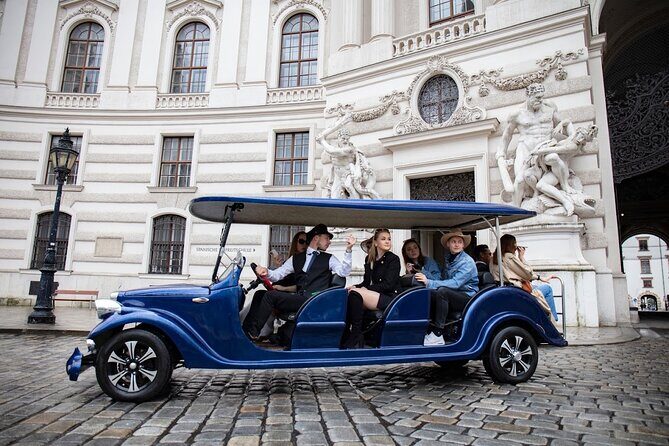
- Private group up to 7 means the pace can fit your crew instead of a bus rhythm
- English guide on a pre-set route through Vienna’s most recognizable civic and imperial spots
- Hofburg + Maria Theresa’s monument area gives you a clear story of power and urban change
- Ringstraße-era landmarks (Parliament, Burgtheater, City Hall, University) show Vienna’s official face
- Opera and concert-hall stops help you decide if you want tickets later
- Short walk included so you’re not only staring at buildings from a car window
The value of a 1-hour panoramic loop in Vienna
Vienna is one of those cities where the first day can feel like drinking from a fire hose. This tour helps because it compresses a lot of the must-sees into about 1 hour. You don’t need to study a map beforehand; you just need a willingness to look up.
The biggest practical win is that you leave with a mental grid. You’ll connect the dots between imperial Vienna (Hofburg), civic Vienna (Parliament and City Hall), academic Vienna (University of Vienna), and the arts circuit (Burgtheater, Opera, Musikverein). That matters because Vienna’s neighborhoods and landmarks are close enough to feel walkable, but far enough that you want a plan.
Also, the price works differently than a typical per-person tour. At $212.93 per group (up to 7), you can spread the cost across several people. For families, friend groups, or couples traveling with a third/fourth person, it can be a very efficient way to get guided context without paying for multiple separate tickets.
You can also read our reviews of more city tours in Vienna
Hofburg: the imperial palace that shaped winter Vienna
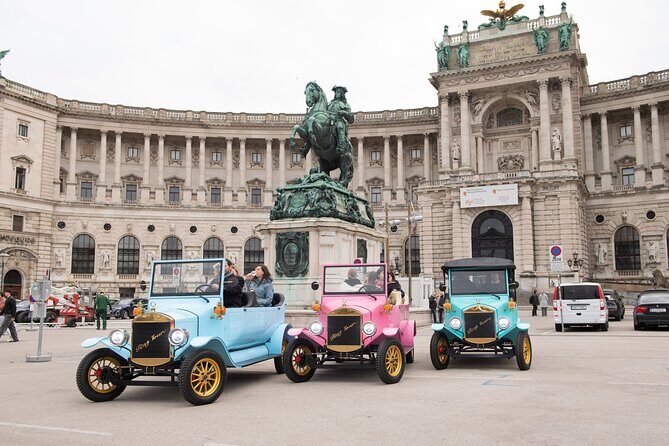
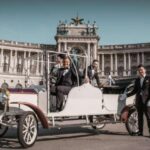
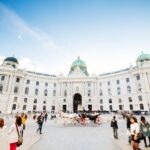
Your tour centers on the Hofburg, the former principal imperial palace of the Habsburg dynasty. This isn’t a random old building stop—it’s the anchor point for understanding why Vienna looks the way it does. The Hofburg started as a construction project in the 13th century under Ottokar II of Bohemia, then expanded repeatedly.
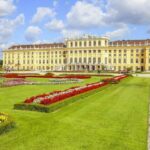
Here’s why I like this stop for first-timers: it sets up a timeline you can carry with you. The Hofburg served as the imperial winter residence, while Schönbrunn Palace was the summer home. Even if you never step foot in either, that winter-vs-summer idea helps you understand how Vienna functioned as a living administrative and cultural center.
You’re also in the center of Vienna, so the setting reinforces the scale. When you see Hofburg from outside (as you’ll do on a panoramic ride), it’s easier to picture how power moved through the city.
Maria Theresa’s monument: power becomes a permanent address
Not far away, you’ll get the area tied to Empress Maria Theresa (1717–1780). Memorial monuments for Habsburg rulers took time, but this one took a little longer—and it’s dated to the late 1800s. Her successor Franz Joseph unveiled it in 1888.
The timing is more than a date. Late 19th-century Vienna saw heavy construction works, especially as architects filled space created by the removal of city fortifications. The monument sits in a context where the city was literally re-making itself, not just decorating old walls.
Maria-Theresien-Platz: museums facing each other for a reason
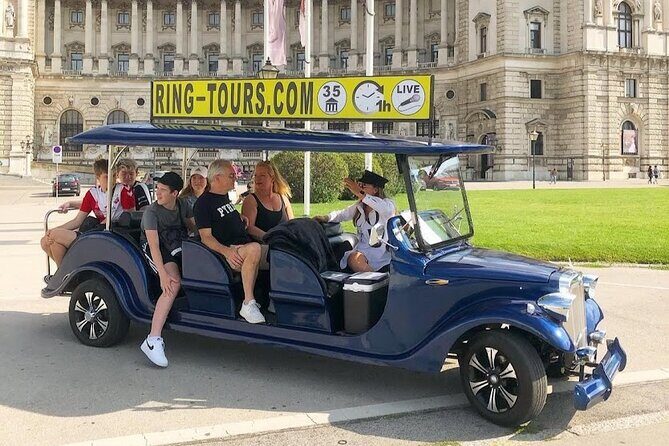
You’ll pass through the museum focal point around Maria-Theresien-Platz, where the Kunsthistorisches and Naturhistorisches museum buildings face each other across the square. This “two giants across from each other” layout is useful: it gives you a quick sense of Vienna’s idea of culture—art and natural sciences sharing the same stage.
One stop on the route is the Natural History Museum Vienna (NHM Vienna), described as one of Austria’s largest museums and non-university research institutions, and an important center of excellence for natural sciences. Even if you don’t go in (and this tour is short), passing by is still worth it because the museum’s mission is tied to research, not only exhibition. It helps you frame Vienna’s museums as working institutions, not just pretty rooms.
If you like this kind of framing, use the ride to note what you’d want to return for. This tour can tell you where your curiosity should spend money and time later.
Ringstraße icons: Parliament, Burgtheater, City Hall, University
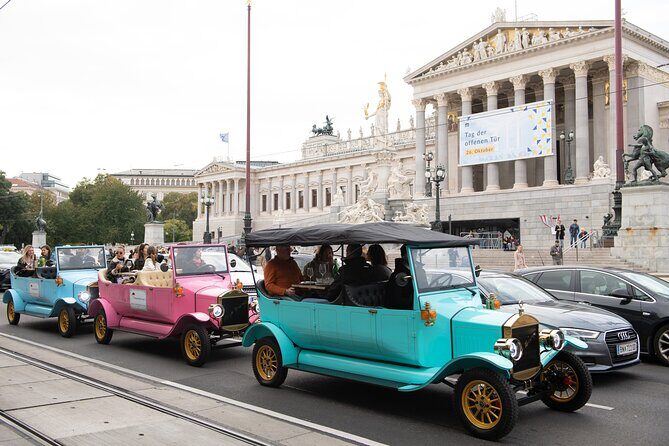
A big chunk of the route focuses on the grand civic and educational buildings clustered near the Ringstraße area. This is where Vienna’s “official face” becomes clear.

Austrian Parliament Building: two houses, one meeting place
The Austrian Parliament Building is where Austria’s two parliamentary houses meet. It sits on the Ringstraße in Innere Stadt, near the Hofburg and the Palace of Justice. Passing it on the route is valuable because it reinforces the idea that Vienna wasn’t only about emperors and palaces. The city’s governance lives right in the middle of the same landscape.
Burgtheater Court Theater: Germany-language theater with global weight
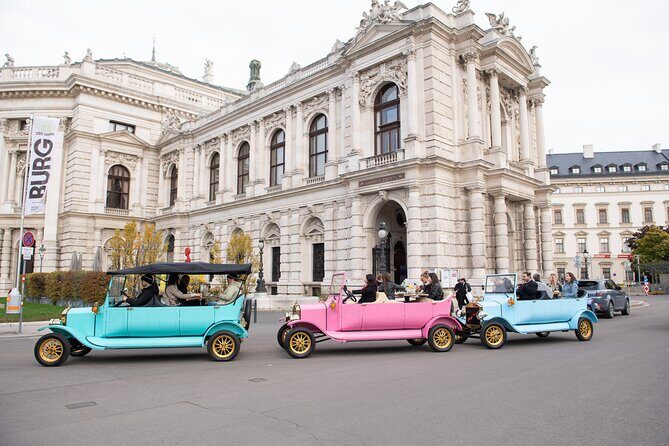
Next comes the Burgtheater Court Theater, Austria’s national theater. It’s noted as the most important German-language theater and one of the most important theaters in the world.
Even if you’re not booking tickets right away, this stop helps you decide whether you care. If the theater world interests you, Vienna’s major venues are not interchangeable. Seeing the Burgtheater in context makes it easier to choose later between plays, opera, and concerts.
Vienna City Hall: Gothic Revival with a build date you can picture
The Vienna City Hall (Rathausplatz) is a Gothic Revival building designed by Friedrich von Schmidt and constructed between 1872 and 1883. That build window is handy because it tells you the style isn’t random; it’s tied to a specific period of city identity-making.
I like this stop because you can often sense the “city” energy here. It’s not just court life or national institutions. It’s Vienna acting like a modern capital with a municipal personality.
University of Vienna: founded 1365, still a major institution
Then there’s the University of Vienna, founded by Duke Rudolph IV in 1365. It’s described as the oldest university in the German-speaking world and among the largest institutions of higher learning in Europe.
For me, this is the quiet reminder that Vienna’s great buildings aren’t only about kings and crowds. They’re also about education and long-term institutions. If you’re the kind of traveler who likes to understand cities through their schools, you’ll appreciate this stop more than you’d expect.
The café stop: where big names (and bigger ideas) met
One of the most interesting parts of the route isn’t a building with a formal function. It’s a café scene. The café opened in 1876, and by the late 19th century it became a key meeting place for the Viennese intellectual scene.
The list of regulars is the kind that makes Vienna feel like a novel. Names connected with philosophy, psychology, literature, architecture, and politics appear—Peter Altenberg, Theodor Herzl, Alfred Adler, Egon Friedell, Hugo von Hofmannsthal, Anton Kuh, Adolf Loos, Leo Perutz, Robert Musil, Stefan Zweig, Alfred Polgar, Adolf Hitler, and Leon Trotsky.
That range matters because Vienna’s cultural story isn’t one-note. It includes brilliance and controversy in the same city conversation. The data also mentions that in January 1913 the café had patrons including Josip Broz Tito, Sigmund Freud, and Stalin. And during the wars, people played Tarock games, with Tapp Tarock especially popular.
You won’t need to understand every name to get the point. This stop gives you a feeling for how ideas circulated in everyday spaces. If you enjoy real social history instead of only official monuments, this is the kind of moment that makes the whole hour memorable.
Spanish Riding School, National Library, and Albertina: arts and discipline
If you want a Vienna tour that includes culture beyond monuments, this route delivers.
Spanish Riding School: classical dressage in Hofburg
The Spanish Riding School focuses on preserving classical dressage and training Lipizzaner horses, with performances tied to the Hofburg. The leading horses and riders also periodically tour and perform worldwide.
For planning, this stop helps you decide whether you want to build your trip around a performance. Even if you can’t fit a show, the fact that the institution is about training and preservation tells you this isn’t casual sightseeing—it’s craft and continuity.
Austrian National Library: 12 million items and a Baroque location shift
The Austrian National Library is described as Austria’s largest library, with more than 12 million items across collections. It’s located in the Neue Burg Wing of the Hofburg. Since 2005, some collections have been relocated within the Baroque structure of Palais Mollard-Clary.
That 2005 detail is useful. It signals that even major institutions keep evolving, not just museum objects freezing time. When you pass by on a short tour, it’s a reminder to look beyond the façade and think about where knowledge is physically stored and how it’s managed.
Albertina: one of the world’s biggest print rooms
Then you’ll head to the Albertina museum in Innere Stadt. What stands out in the details is its print-focused strength: about 65,000 drawings and around 1 million old master prints, plus modern graphic works, photographs, and architectural drawings.
Even if prints aren’t your thing, this matters for two reasons. First, it explains why Albertina has a distinct identity compared to general art museums. Second, it helps you decide what kind of museum time you want later. If you love paper art, drawings, or printmaking, this is the one to prioritize.
Vienna State Opera and Musikverein: two different kinds of performance energy
The route also touches the big performance venues that make Vienna famous for music and stagecraft.
Vienna State Opera: Renaissance Revival and first on the Ring Road
The Vienna State Opera is both a historic opera house and an opera company. The venue is described as a 1,709-seat Renaissance Revival building and the first major building on the Vienna Ring Road.
That combination—historic stage + specific size—helps you imagine the atmosphere. It’s big enough to feel grand, but not so huge that it loses theater intimacy.
Wiener Musikverein: home of the Vienna Philharmonic
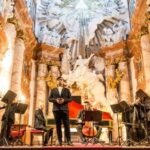
Next is the Wiener Musikverein (Musikverein), opened in 1870 and home of the Vienna Philharmonic Orchestra. This is one of those places where knowing the orchestra connection changes your expectations. Even from the outside, it tells you this is a concert venue built for serious music-making.
If you’re torn between opera and concerts, this tour helps you weigh your priorities. You can notice how you feel about the venues you pass, then choose what to book when you have time.
Karlskirche: Baroque church at Karlsplatz
The last highlighted architectural stop is Karlskirche, a Baroque church on Karlsplatz. It’s dedicated to Saint Charles Borromeo, identified here as a leading figure of the Counter-Reformation.
What I like about ending with a church is tone. After palace power and civic buildings, you get a calmer, more symbolic kind of stop. It’s also positioned on the border of Wieden and Innere Stadt, so it feels like a transition point between city center and surrounding districts.
Price and logistics: when $212.93 is a smart move
Let’s talk value honestly. $212.93 per group (up to 7) for about 1 hour can be a strong deal if you’re traveling as a small group and want guided interpretation without spending hours hopping lines.
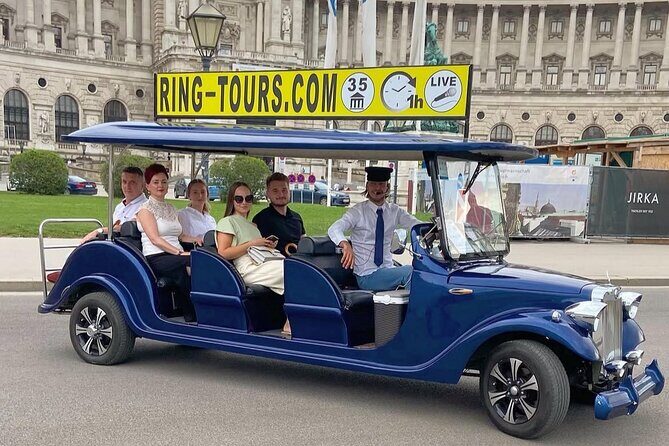
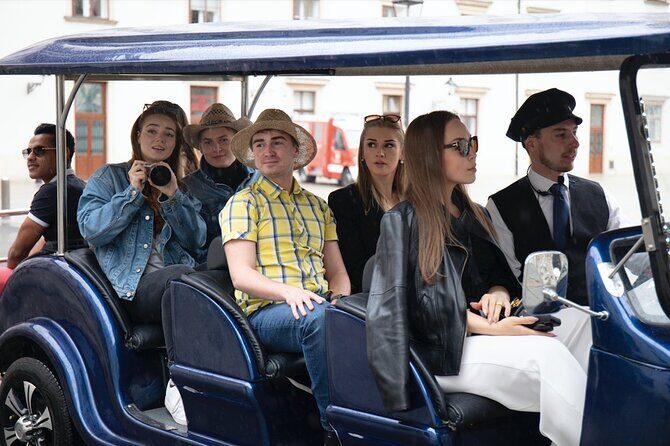
This is a private tour, meaning only your group participates. That matters because you can ask questions as you go and adjust pacing to what your crew cares about most. The tour is offered in English, and you’ll use a mobile ticket.
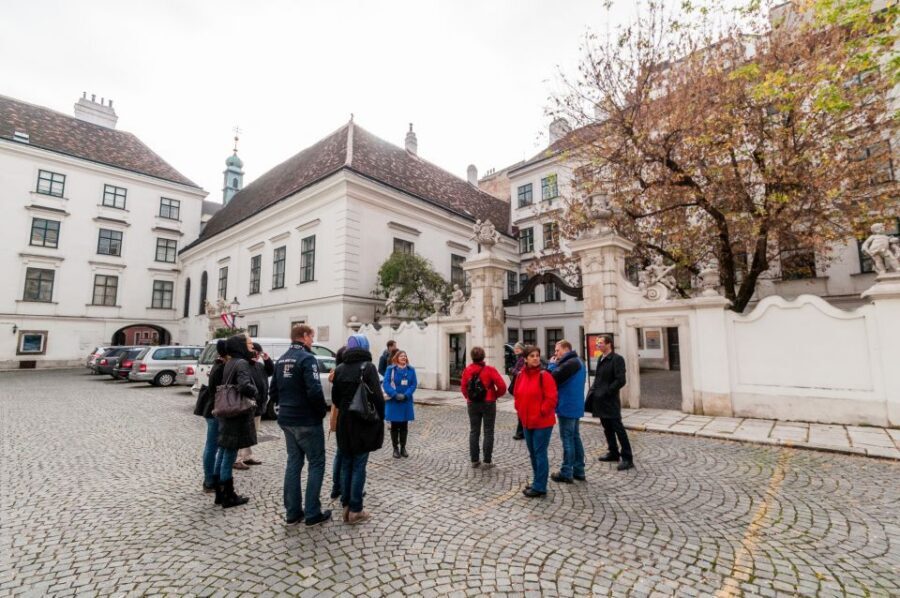
It starts at Führichgasse 8, 1010 Wien and returns back to the same meeting point. That simple loop is practical in a city where walking to the wrong place can eat up time fast.
One small caution: because the emphasis is panoramic passing by major landmarks, you should still plan your day so that you can revisit the 1–2 places that catch your attention most.
Tips to get the most from your hour
Here’s how I’d do it so you leave with more than photos:
- Arrive with a shortlist of what you care about most: imperial sites, civic buildings, music, or museums.
- Pick your follow-up targets before the tour ends. This route gives you multiple “return later” candidates, including Hofburg, Albertina, and the opera/concert venues.
- Wear shoes you can move in. Even though it’s panoramic, there is a walk included in the experience you’re signing up for.
- Use the café stop for context, not for deep research. The intellectual-scene details are exactly the kind that make Vienna feel alive fast.
Should you want extra time later, you’ll know where to spend it because the tour gives you the map in your head.
Should you book this panoramic Vienna landmarks tour?
Book it if you want a fast, guided way to connect Vienna’s biggest names into a coherent story. It’s especially a good fit for first-time visitors, people with limited time, and groups up to 7 who want a private setup without paying per person.
Don’t book it if your main goal is deep museum time or long interior visits. This tour is built for seeing and understanding, then deciding what to revisit. If you like that style—efficient, guided, and focused on getting your bearings—you’ll probably love how much you get done in a single hour.
FAQ
Is this a private tour?
Yes. Only your group will participate.
How long is the tour?
It runs for about 1 hour.
What language is the tour offered in?
The tour is offered in English.
How much does it cost?
It’s $212.93 per group, up to 7 people.
Where does the tour start?
The meeting point is Führichgasse 8, 1010 Wien, Austria.
Does the tour end at the same meeting point?
Yes. The activity ends back at the meeting point.
Do I need to bring a paper ticket?
No. The tour uses a mobile ticket.
Are service animals allowed?
Yes, service animals are allowed.
Is the meeting point near public transportation?
Yes. It’s near public transportation.
Is there free cancellation?
Free cancellation is available. You can cancel up to 24 hours in advance for a full refund.