REVIEW · GRAZ
Graz Private Walking Tour
Book on GetYourGuide →Operated by Travmonde OÜ · Bookable on GetYourGuide
Graz has a way of making you look twice at buildings. This private 90-minute walk connects Habsburg-era power to today’s Kunsthaus and the city’s living cultural identity. I especially like how the route mixes famous landmarks with smaller architectural surprises, so you’re not just collecting photos.
I also love the storytelling quality—our guide focus keeps the details human and understandable, and in one recent group the guide Leo made the whole day feel smoother with practical ideas after the tour. One thing to consider: with a tight 90 minutes and lots of stops, comfortable shoes matter, and you’ll want to pace yourself if you’re slower than average.
In This Review
- Key Highlights You’ll Care About
- Graz in 90 Minutes: A Private Tour That Actually Works
- Meeting at Hauptplatz and Getting Oriented Fast
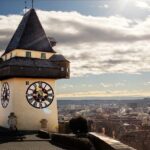
- Schlossberg Hill: Where the Middle Ages Make Sense
- Hauptplatz and Town Hall: Reading Civic Power in Stone
- Luegg House, the White House, and Eagle Pharmacy
- Palais Sturgkh and Archduke Johann (1878) Moments
- Landhaushof Courtyard: Renaissance Impact in One Stop
- Kunsthaus Graz: When the 21st Century Blinks Back at You
- Price and Value: What $289 Gets You for a Private Group
- Who This Tour Suits Best
- Should You Book This Graz Private Walking Tour?
- FAQ
- How long is the Graz Private Walking Tour?
- Where does the tour meet?
- How much does it cost?
- Is this a private tour?
- What languages are available?
- Are entrance fees included?
- What should I bring?
- Is there free cancellation?
- Can I book and pay later?
Key Highlights You’ll Care About
- Private guide attention: you move as one group with a local guide focused only on your questions
- Schlossberg hill start: an easy way to get the city’s Middle Ages in context right away
- UNESCO Old Town fabric: you see why the district is considered one of the best-preserved in central Europe
- Architectural variety in short form: Luegg House, the White House, Eagle Pharmacy, and palaces in one loop
- Politics + religion through place: the Styrian Diet influence shows up in how the city organized power
- Old/new contrast at Kunsthaus Graz: a modern “blob-like” landmark after centuries of stone and stucco
Graz in 90 Minutes: A Private Tour That Actually Works
A private walking tour in Graz is a great way to get oriented fast, without doing the whole city in “box-checking mode.” This one is 90 minutes, and it’s structured around the big ideas that shape Graz: Habsburg residence life, Styrian political institutions, religious and political background, and the city’s modern creative identity.
The format is also simple and practical: you have a local guide with just your private group. That matters, because Graz rewards curiosity. When you can ask follow-ups on why one building looks the way it does—or how a political institution left its mark—you get more out of every corner.
Your starting point is in the center of town at Hauptplatz 1, right by the fountain in the middle of the square. From there, the walk moves up and through the historic core, then shifts you toward a modern anchor at Kunsthaus Graz. You’ll finish with a feel for why Graz gets nicknames like UNESCO City of Design, City of Human Rights, and the Culinary Capital City of Austria—these aren’t just slogans. They connect back to planning, people, and cultural choices over time.
You can also read our reviews of more walking tours in Graz

Meeting at Hauptplatz and Getting Oriented Fast
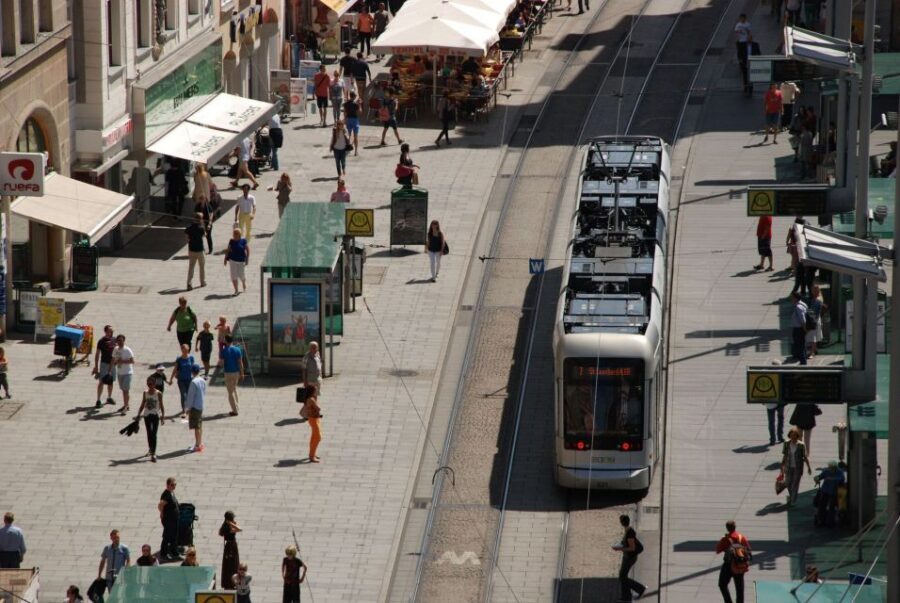
Meet in the main square—Hauptpl. 1, next to the fountain in the center. It’s a good spot because it’s easy to find and it places you right in the heart of the story. Even before you start walking, you’re in the same kind of public space where power and daily life overlap.
From there, the tour starts by looking upward—at Schlossberg hill above the city. That’s not just a nice view strategy. It’s a smart way to understand Graz’s layered geography: you see how a city could protect itself, control movement, and also host merchants and traders. The tour specifically frames Schlossberg as a Middle Ages setting when Graz was home to Slavic merchants and traders. That early mix helps explain the city’s long-running role as a crossroads, not a sealed-off capital.
You’ll then work back down through key sights connected to imperial and civic life. The guiding idea is contrast: stone-and-stucco Graz meets 21st-century design at the end. If you like cities that let you compare eras in the same stroll, you’ll enjoy how the route is built to do that.
Schlossberg Hill: Where the Middle Ages Make Sense
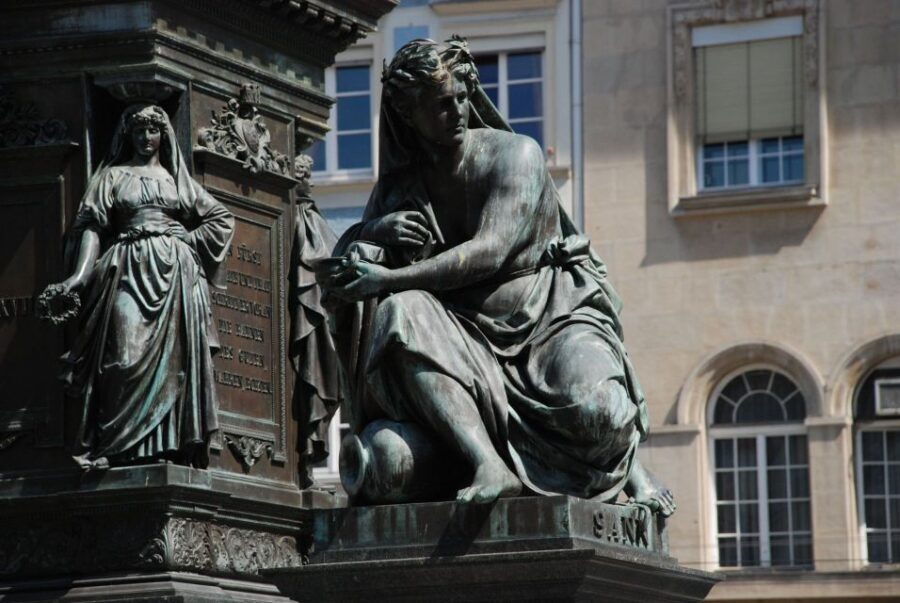
Starting at the Schlossberg hill is one of the best choices for a short tour. You don’t just get a panorama; you get the logic. Graz’s hill above the city is presented as a Middle Ages testimony and a place tied to early commerce—specifically the presence of Slavic merchants and traders. That detail makes history feel less like a list and more like a living system.
From this point, the tour naturally sets up the “big theme” you’ll keep hearing: Graz’s importance as a Habsburg residence. The Habsburg story isn’t delivered like a history lecture. It’s tied to how and why spaces look the way they do—where buildings stand, how squares function, and what kinds of institutions claim visibility.
If you’re the kind of person who loves a city view but hates when it turns into one minute of sightseeing and then nothing else, this start is for you. The viewpoint supports the rest of the walk. It also helps you keep your bearings, which is huge when you’re moving through narrow lanes and architectural details.
Hauptplatz and Town Hall: Reading Civic Power in Stone
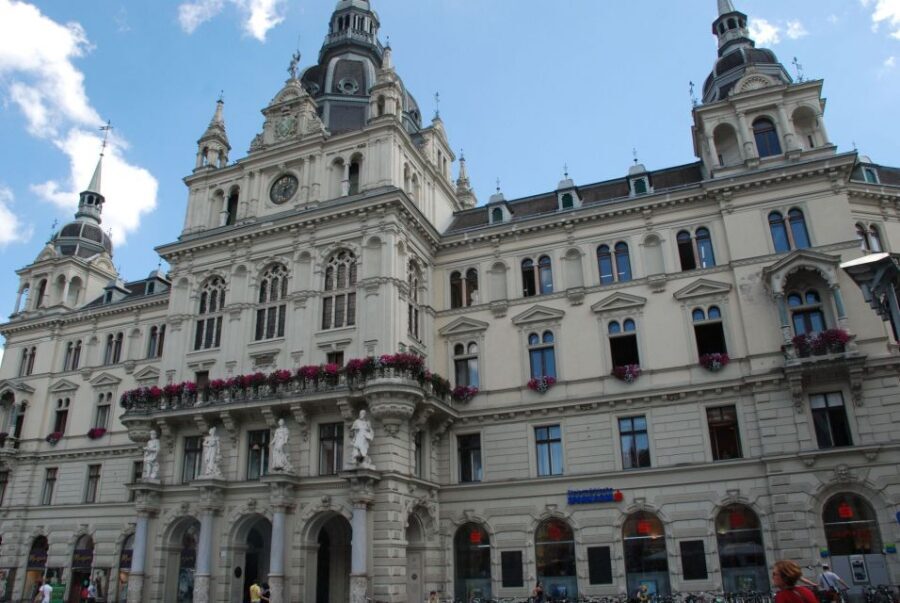
Once you’re back around Hauptplatz, the city’s civic center comes forward. The tour notes that the Town Hall dominates the market square, and that’s exactly why this stop works. A town hall isn’t only a pretty façade; it’s a visual signal of governance and public life. Even in a compact route, the guide’s job here is to help you connect what you see with what it meant.
As you walk, you’ll get a sense for why Graz earned its UNESCO Old Town status in 1999 and why the historic district is considered among the best-preserved in central Europe. This matters because preservation changes the visitor experience. You’re not just looking at isolated landmarks; you’re seeing a coherent urban fabric—romantic alleys, old-school street rhythm, and building styles that still “agree” with each other.
You’ll also hear how Graz’s identity developed through layers of culture—imperial residence life on one side, and local creative energy on the other. That’s where the later stop at Kunsthaus will click.
Luegg House, the White House, and Eagle Pharmacy
This is where architectural details turn into story. The tour includes several standout façades that are worth seeing closely, especially because the route keeps moving and you don’t get stuck staring at one building for too long.
Luegg House (17th century) is highlighted for its impressive stucco façade. Stucco can look like decoration until you understand it as status and craftsmanship made visible. The guide’s emphasis here helps you see why such work mattered in a historic imperial context.
Next comes the White House, described as a five-story building with a sandstone relief of the Virgin Mary. That’s a great example of how religious imagery mixes into everyday civic architecture. It’s not only about belief; it’s about public messages—what a community chose to place where people would actually see it.
Then there’s the Eagle Pharmacy (16th century), a name that already sounds like a clue you’re supposed to notice. Pharmacy buildings in old European cities often signal more than trade—they point to guild life and civic services. In this tour, it’s treated as part of Graz’s “unique music and architectural heritage” angle: the city’s identity shows up in places you might not expect.
Practical note: these details are best seen at a slow walking pace. If you’re tempted to speed up for photos, try at least a few seconds of looking before you move on.
You can also read our reviews of more private tours in Graz
Palais Sturgkh and Archduke Johann (1878) Moments
After the façade highlights, the tour shifts to palaces and public symbols. Palais Sturgkh (14th century) is included as another anchor for how old power lived in the city. The guide frames it inside Graz’s religious and political background, which is exactly what you want from a short walk: not just dates, but what those buildings were for.
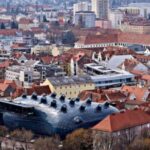
Then you’ll see the fountain and statue of Archduke Johann, dating from 1878. Including this is smart because it connects the Habsburg legacy to a later moment in time. It’s one more layer that helps you see Graz as a city where political memory doesn’t vanish—it gets rebuilt into monuments and streets.
If you like “why is that here?” explanations, this is one of the best segments. A tour that only names buildings is fine. A tour that helps you read the city’s intentions makes it stick.
Landhaushof Courtyard: Renaissance Impact in One Stop
One of my favorite parts of any architecture-focused walk is when you get inside the “why” behind a building layout. The tour includes the Landhaushof, noted for a remarkable Renaissance courtyard—the first Renaissance courtyard in the city.
That detail matters because courtyards aren’t just aesthetic. They’re social and administrative space. A Renaissance courtyard implies a certain idea of order, status, and controlled openness. Even if you’re not a design nerd, you can usually feel the difference in how a courtyard organizes movement and light.
This stop also connects back to the tour’s political theme: the historic Styrian Diet and its influence. You’re seeing how institutions left physical marks. In Graz, politics isn’t an abstract concept—it sits in stone, proportion, and the way spaces are arranged.
If you tend to remember cities by “rooms and routes,” this is a good stop. It helps your brain map the city beyond streets and façades.
Kunsthaus Graz: When the 21st Century Blinks Back at You
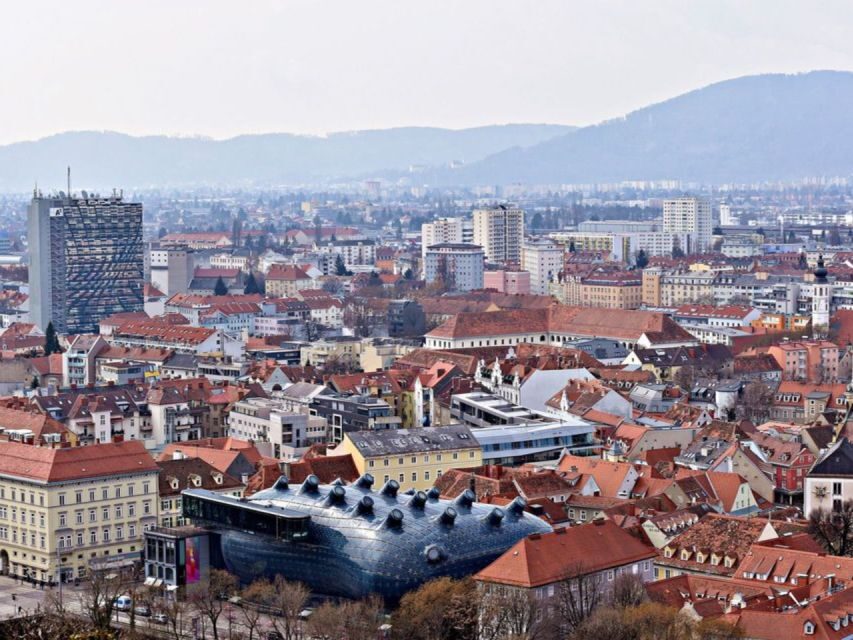
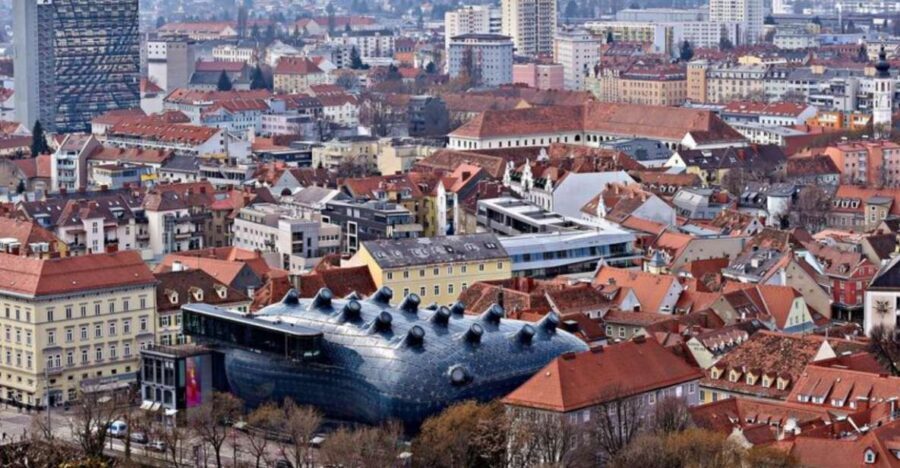
After all the older layers, the tour brings you to the Kunsthaus—Graz’s newest exhibition space—with “blob-like ultramodern architecture.” That wording is simple, and it sets expectations. This isn’t trying to imitate history. It’s presenting a clear contrast.
This final phase is more than a photo stop. It gives the whole tour meaning. You’ve spent time with imperial residence signals, religious and political background, and architectural heritage. Then you see Graz’s modern creative identity in a building that doesn’t try to blend in.
The guide also ties this back to Graz’s cultural scene. That’s the real payoff: you walk away understanding that Graz isn’t only a pretty old-town museum. It keeps producing ideas, staging exhibitions, and building new ways for people to gather.
If you’re planning more time in the city afterward, this stop is a great mental reset. You’ll start noticing modern references in the old streets instead of treating them as separate worlds.
Price and Value: What $289 Gets You for a Private Group
The price is $289 per group, up to 15 people, for 90 minutes. That can sound steep if you’re thinking like a solo traveler, but private tours are priced for group value and guide time, not per-person math.
So here’s the practical way to judge the value: if you’re going with a couple, a small group of friends, or family, the cost becomes more reasonable fast. And because it’s private, you’re not sharing the guide with strangers who might not care about the details you do.
Is it worth it for a group of 15? It depends on your group’s style. If you want one guide to manage everyone’s questions, move at a steady pace, and keep the story coherent, a larger group can still work. But if your group likes slower pacing at each façade, you’ll feel the time pressure. The tour is designed to cover a lot, so the “worth it” part comes from your ability to enjoy a guided sprint through the city’s key identity points.
In short: the value is strongest when you’ll actually use the guide. If you’re likely to ask questions and linger for small details, the price makes sense.
Who This Tour Suits Best
This private walking tour is a great fit if you want:
- An overview that still feels specific, not generic sightseeing
- A focus on architecture, institutions, and story
- A smooth route that connects old imperial Graz to modern design
It’s especially good for couples, friend groups, or families who want guided context but don’t want a big crowd. The private format also supports a flexible feel. In one recent booking, the guide Leo worked in response to the group’s wishes, which is exactly what you want from a private tour rather than a scripted one-size walk.
Who might want something else? If you only care about one or two major sights and you prefer free roaming, a walking tour might feel too structured. But if you like the idea of learning how Graz became Graz—Habsburg residence, Styrian Diet influence, religious and political background, and the modern art scene—this is a strong match.
Should You Book This Graz Private Walking Tour?
Yes—if you want a guided route that helps you read Graz instead of just passing through it. The tour’s best strength is the way it links places to themes: imperial residence life, civic power around Hauptplatz, Renaissance courtyard space, and the contrast of Kunsthaus’s modern design.
Also, the guide impact seems real from recent experiences. Leo’s storytelling and the group-specific feel—along with actionable suggestions for what to do later—are signs that you won’t get a checklist tour. You’ll get a walk that makes the city easier to enjoy for the rest of your day.
If you’re in Graz with limited time and you want the “why” behind the look of the city, this private 90-minute format is a smart use of your time.
FAQ
How long is the Graz Private Walking Tour?
The tour lasts 90 minutes.
Where does the tour meet?
You meet next to the fountain in the middle of the square, Hauptpl. 1, 8010 Graz, Austria.
How much does it cost?
It costs $289 per group, up to 15 people.
Is this a private tour?
Yes. It’s a private group tour, with a local guide who is with your group only.
What languages are available?
The live guide is available in German and English.
Are entrance fees included?
No. Entrance fees are not included.
What should I bring?
Wear comfortable shoes.
Is there free cancellation?
Yes. You can cancel up to 24 hours in advance for a full refund.
Can I book and pay later?
Yes. You can reserve now and pay later.