REVIEW · GRAZ
Kunsthaus Graz Museum Entrance Ticket
Book on Viator →Operated by Universalmuseum Joanneum · Bookable on Viator
The Kunsthaus Graz hits you fast. This self-guided admission ticket drops you into contemporary art inside one of Graz’s most talked-about buildings. I like two things right away: the museum’s strange, memorable architecture and the chance to explore Austrian and international contemporary art without rushing. One drawback to keep in mind: Kunsthaus Graz is built around temporary shows, so what you see depends on the dates you go.
Plan for about two hours of wandering at a comfortable pace. It’s designed for you to move through galleries on your own, and you can add an audio option only if you want it. If you’re hoping for a big permanent collection, you might feel a little short—especially if the current exhibitions don’t match your taste.
In This Review
- Key points before you go
- Entering the Kunsthaus Graz: an alien-feeling building on the Mur
- What your $15.38 ticket really includes (and what costs extra)
- Your visit plan: a relaxed 2-hour self-guided route
- What you’ll likely see inside: voice, power, and modern provocation
- Architecture, movement, and the way you experience the rooms
- Location and timing: when to fit it into your Graz day
- Do you need the English audio guide?
- Price and value check: good deal for the right kind of visit
- Who should book this Kunsthaus Graz entrance ticket
- Should you book? My straight answer
- FAQ
- How long should I plan to spend at Kunsthaus Graz?
- Is a guided tour included with the ticket?
- Are English options available?
- What are the opening hours?
- How do I get my ticket?
- Is there a free entry day?
Key points before you go
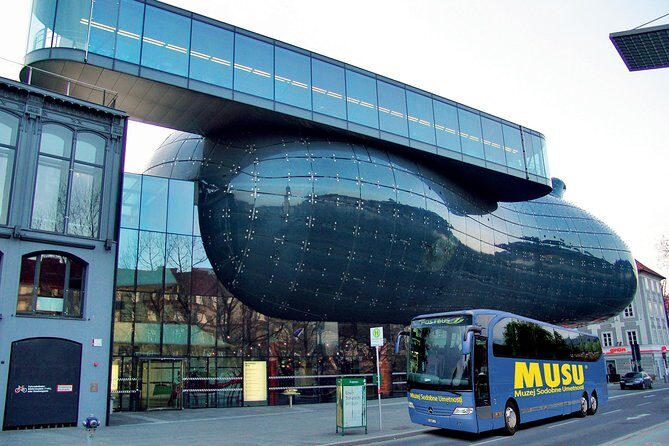
- Surreal building, real payoff: expect a very distinctive design that shapes the way you move through the museum
- Temporary exhibitions only: the programming changes, so timing matters
- Easy self-guided visit: you can go at your pace instead of syncing with a group
- Moving ramps and multiple levels: the layout isn’t one straight hallway
- Top-floor views: the museum is known for a strong vantage from the upper levels
Entering the Kunsthaus Graz: an alien-feeling building on the Mur
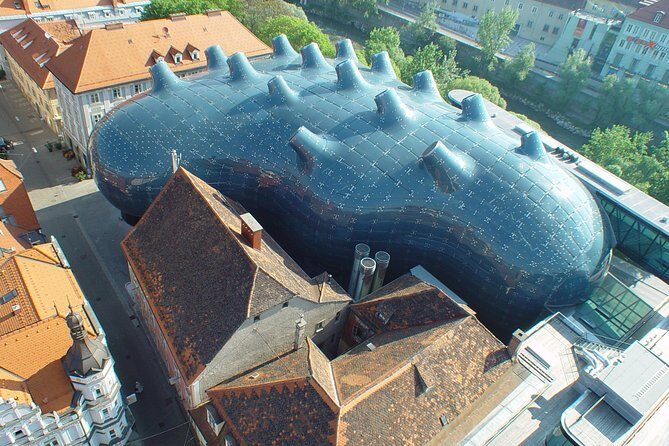
The Kunsthaus Graz is famous for a reason. It looks like something that shouldn’t belong among Graz’s older streets, and that’s part of its charm. The building is often described like a friendly alien or a blue heart sitting on the riverbank, and when you’re standing by it, you get why people call it surreal.
Inside, the museum doesn’t feel like a copy-paste box. You’re guided upward through the experience, with the exhibition spaces on the upper floors. One practical detail: you’ll likely make your way between levels using the museum’s moving ramps, not just stairs. That matters because it sets the rhythm. You don’t just pop into a room and leave—you get a slow, continuous flow, which helps for modern art that rewards looking longer.
There’s also a shop and bar on the ground floor, which is handy if you want a quick break before you start climbing through the exhibitions. And if you like a good view, plan time for the upper-floor panorama. The museum’s location is close to the historic core, and Graz’s skyline is part of the atmosphere.
You can also read our reviews of more tours and experiences in Graz.

What your $15.38 ticket really includes (and what costs extra)
You’re buying admission to Kunsthaus Graz for about $15.38 per person, with all fees and taxes included. That’s the big value point: your price is straightforward. You don’t need to add a lot of “gotchas” to make the visit happen.
This ticket is self-guided, so no guided tour is included. If you want extra help, the museum offers audio guides/printed support options that cost 3 EUR per person. The languages listed for the audio option are English and German, with some content in Italian and Slovenian. So if you don’t read German, this can still work, but it’s an add-on.
One more detail that affects your wallet: you may see prices or value comparisons online that ignore the fact that many modern museums separate admission from interpretation tools. Here, you start with admission, then decide if you want the voice in your ear.
Your visit plan: a relaxed 2-hour self-guided route
The experience runs about two hours on average, and that fits the way the museum is built. With self-guided entry, you’re not forced into a tight schedule. You can spend longer where a piece grabs you and move quickly past what doesn’t.
Here’s a pacing tip that usually works well in modern art spaces: give yourself short segments. For example:
- first pass: just get oriented and skim the main rooms
- second pass: stop for the pieces that actually hold your attention
Because the exhibitions are temporary, you may not find huge numbers of works in every room. That can be a plus. You don’t feel like you’re sprinting through hundreds of minor things. Instead, you get fewer installations and artworks with room to think.
Also, the museum has multiple floors, so your visit naturally expands if you slow down for the views or want to replay audio interpretation. If you’re the type who likes to read labels carefully and sit with installations, 2 hours may stretch a bit. If you just want the highlights and photos, you can usually do it faster.
What you’ll likely see inside: voice, power, and modern provocation
Kunsthaus Graz is all about contemporary art that’s willing to be weird, uncomfortable, political, or emotionally intense. That’s why the museum works even when you’re not an art scholar. The building sets the mood, and then the exhibitions bring the ideas.
Depending on dates, you might encounter shows that lean into:
- voice and sound as the main medium (think installations with whispered audio, disembodied sounds, and dark rooms that make listening feel physical)
- political power as a theme, sometimes shown through multimedia or video works
- topics like feminism and violence, where the work aims to unsettle and force a second look
Even when the exact exhibitions change, the museum tends to pick concepts that don’t behave like traditional painting galleries. Instead of only standing and staring at framed art, you’re often moving through experiences. You may find rooms that feel darker or more atmospheric than you expect. That’s part of the design logic: it encourages you to pay attention to sound, scale, and pacing.
One thing I like about this approach is that you don’t need to “get it” instantly. You can let an installation be confusing for a minute and still come away with something real—sometimes it’s an emotional reaction, not a tidy explanation. If you’re the type who wants art to be challenging in a controlled environment, this museum often delivers.
Architecture, movement, and the way you experience the rooms
The building’s design isn’t just for exterior photos. It changes the feel of the interior. Since exhibition spaces are arranged on upper levels and you’re moving via ramps, you get a continuous “journey” rather than a stop-and-start walk.
That matters for contemporary art because many works are about tension: silence versus noise, presence versus absence, crowd versus isolation. A museum layout that guides your movement can support those themes. You’re not always in full control of where the next room takes you, which means you’re less likely to treat the visit like a checklist.
There’s also a practical side. If you get tired easily, plan breaks. Use the ground-floor shop/bar as a reset before continuing upward. And when you reach the upper viewing area, take a moment there too—not just for photos. Looking out helps your brain switch modes from absorbing intense art to scanning the city.





Location and timing: when to fit it into your Graz day
Kunsthaus Graz is on the Lendkai 1 area, and it’s close enough to the historic center that you can pair it with other sightseeing. It sits by the river, and that makes it easy to build into a walk day instead of treating it as a separate mission.
Opening hours are:
- Tuesday to Sunday: 10:00 AM – 6:00 PM
These hours apply for the main operating periods listed for 2025 and into 2026–2027.
Best timing tip: if you like calmer galleries, go earlier in the day. If you love city views, aim for a time when the light outside is still decent—because you’ll be tempted to linger once you get up top.
Getting there is also low-stress. The museum is noted as near public transportation, so you’re not dependent on taxis or long walks from the edge of town.
If your plans are uncertain, you also have the option of free cancellation if you cancel at least 24 hours ahead. That kind of flexibility is useful when Graz weather or day trips change last minute.
Do you need the English audio guide?
With this ticket, you’re not required to buy interpretation tools. You can walk in and enjoy the exhibitions at your own pace with just the basic admission.
That said, the audio option exists for a reason. Contemporary art can be concept-heavy, and if you want context, audio is the easiest “extra” to add. The listed language coverage is English and German, with partial support in Italian and Slovenian. If English is your comfort language, that’s a clear plus.
My practical take: if you typically read museum labels and you enjoy figuring things out yourself, skip the audio and spend that money on a coffee and time. If you prefer more structure—especially for sound-based installations—then the 3 EUR per person audio cost can feel like it turns the visit from watch-and-wander into a clearer story.
Price and value check: good deal for the right kind of visit
At around $15.38, you’re paying for admission plus access to the museum’s changing contemporary programming. Value depends on your expectations.
If you come in thinking you’ll see a single themed exhibit that lasts forever, temporary programming can disappoint. But if you’re open to seeing what the museum is focusing on right now, it’s often a good deal. The building itself is part of the draw, and the experience is helped by the two-floor circulation design and the well-known upper views.
Also, the ticket includes all fees and taxes, which reduces the “surprise math” you sometimes get with city attractions. And because it’s self-guided, you’re not paying for someone else’s time. It’s a ticket that supports your pace—which is exactly what you want in a modern art museum.
Who should book this Kunsthaus Graz entrance ticket
This works best if you:
- love contemporary art and don’t need it to be comforting
- like museums with a strong visual identity, not just a room with paintings
- want a flexible, self-guided outing that fits into a wider Graz itinerary
It may not be your ideal choice if you:
- are looking for a large permanent collection experience
- want a standard guided tour with a fixed storyline and guaranteed talking points
- strongly prefer traditional, chronological museum layouts
If you’re somewhere in the middle, the building plus the type of exhibitions Kunsthaus tends to run often makes the visit worthwhile even if you don’t love every theme.
Should you book? My straight answer
If you’re in Graz and you’re even slightly curious about contemporary art, book it. The price is fair for admission, and the self-guided format makes it easy to fit into a day without stress. Just don’t assume you’ll see a permanent “greatest hits” collection—this museum changes its mind often, which is either the fun part or the disappointment, depending on what you’re after.
If you’re the kind of visitor who likes sound-based work and political or social themes, you’re in the sweet spot. If you’d rather have a guide explain everything, budget the small extra for audio interpretation or pair your visit with your own reading time before you go.
FAQ
How long should I plan to spend at Kunsthaus Graz?
Plan about 2 hours for your visit. Your time may vary depending on how carefully you want to read and how much time you spend in each exhibition space.
Is a guided tour included with the ticket?
No. This is a self-guided museum admission ticket. A guided tour is not included. Audio guides are available for an extra 3 EUR per person.
Are English options available?
Yes. The paper ticket is offered in English. Audio guides (if you choose to purchase them) include English and German, with some content partly in Italian and Slovenian.
What are the opening hours?
For the listed periods, the museum is open Tuesday to Sunday, 10:00 AM to 6:00 PM.
How do I get my ticket?
To receive your ticket, show your printed booking confirmation from Viator at the cashier point.
Is there a free entry day?
Yes. There is free entrance on June 28th and 29th, 2025 as part of the MIKROtopia Open House event.