REVIEW · VIENNA
Jewish Vienna Walking Tour
Book on Viator →Operated by Insight Cities · Bookable on Viator
Vienna hides big stories in plain sight. This Jewish Vienna walk links synagogues, culture, and memory across the city in just 2.5 hours. I like how the tour keeps its focus on what you can see on the street, from the almost-too-quiet hints of Jewish life to major memorial sites.
Two things I especially value: the guide depth and the pace. You get a historian guide (professors, doctoral students, historians, journalists, art critics, and published authors), and you also move at a comfortable walking rhythm that leaves room for questions. The small group size, capped at 8, helps the tour feel more like a conversation than a lecture.
One possible drawback: you will not go inside the synagogues. You’ll see key places from outside, and if you want an interior visit, you’ll need to arrange that separately with the synagogue (seasonal and limited days).
In This Review
- Key highlights you’ll feel quickly
- A walk that connects street corners to real consequences
- Price and Logistics: what $179.74 means in practice
- Getting your bearings at Stadttempel (Start near Seitenstettengasse)
- Stop 1: Infopoint Jewish Vienna at the Jewish City Temple doors
- If you want the synagogue interior
- Stop 2: Nestroyhof Hamakom’s Art Nouveau and Yiddish culture
- Why this stop matters
- Stop 3: Leopoldstadt and the memorial columns for a destroyed temple
- What to do as you stand there
- Stop 4: Judenplatz Holocaust Memorial and the synagogues you can’t enter
- A good way to approach this emotionally
- The guides: historians who explain without drowning you in dates
- How the pacing usually feels
- What’s included versus not included (and how to avoid surprises)
- Group size, timing, and how to get the most out of it
- Who should book this Jewish Vienna walking tour?
- Should you book it? My honest take
- FAQ
- FAQ
- How long is the Jewish Vienna walking tour?
- Where does the tour start and end?
- What language is the tour offered in?
- Is a mobile ticket included?
- What is included in the price?
- Are there admission tickets included for each stop?
- Is metro fare included?
- How big is the group?
- Can I visit synagogue interiors during this tour?
- What is the cancellation policy?
Key highlights you’ll feel quickly
- Small group, capped at 8 so you can ask questions and keep a steady pace.
- Stadttempel area start at the Jewish City Temple, with context on how Jewish institutions had to stay visible but restrained.
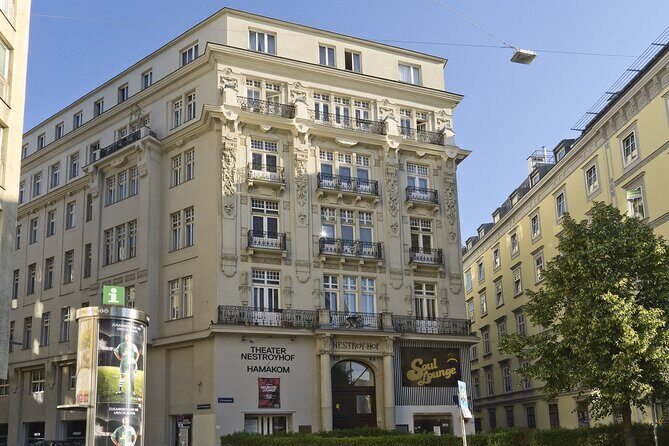
- Nestroyhof Hamakom and Art Nouveau exterior views tied to Vienna’s modern Yiddish cultural scene.
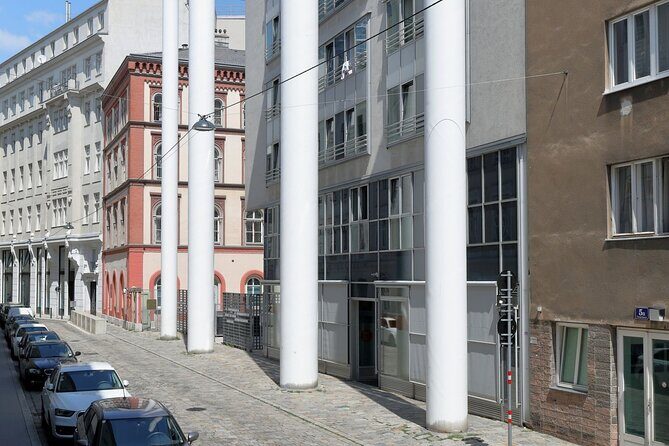
- Leopoldstadt’s four white columns marking the destroyed Leopoldstädter Temple site.
- Judenplatz Holocaust Memorial connecting destroyed synagogues to the long shadow of Nazi genocide and antisemitism.
- Historian guides with storytelling skills, and in past tours people have praised guides like Peter, Jan, Webke, and Annelie Pichler.
A walk that connects street corners to real consequences
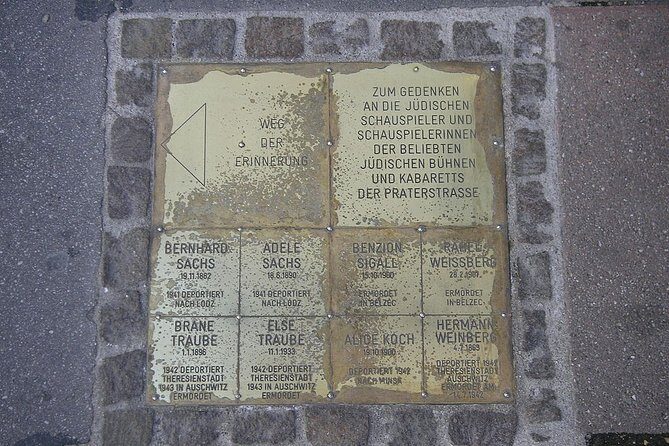
Jewish Vienna is not one neat postcard stop. It’s centuries of community life, interruptions, and survival—plus the way the city chose to remember (or not) those chapters. What makes this tour work is the order of the sites: you start with the city’s Jewish religious presence, then shift to cultural life, then land on memorial spaces that carry the weight of twentieth-century history.
You’ll also notice how Vienna’s architecture plays its own role. Some of what matters here is not only the building itself, but how it was seen from the street. That theme shows up early and keeps echoing as you move through the walk.
Plan for about 2 hours 30 minutes on your feet. The stops are short enough that you still get the story, but long enough that you’re not just skimming plaques while you walk by.
You can also read our reviews of more walking tours in Vienna
Price and Logistics: what $179.74 means in practice
At $179.74 per person, this is a mid-to-higher priced walking tour. The value comes from three places: a guided historian, a small group size, and a tight route that doesn’t waste time.
You’re paying for someone to turn buildings into context—how Jewish communities shaped Vienna, how expulsions and persecution changed daily life, and how the city’s cultural output (including Yiddish-language scenes) links to those realities. If you’ve ever done a city walk where the guide points and reads, this is the opposite. You’ll get explanation and story, and that’s usually what you’re really buying.
Also, most travelers book this in advance (it averages 61 days ahead). That’s a hint to plan early if your dates are fixed.
Getting your bearings at Stadttempel (Start near Seitenstettengasse)
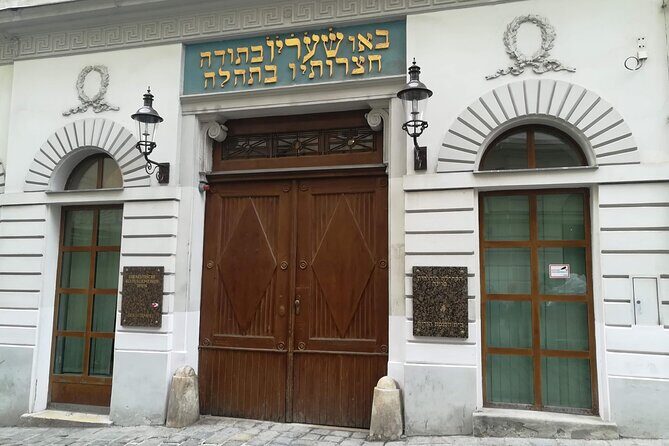
The tour begins at Stadttempel, located at Seitenstettengasse 4, 1010 Wien. The final stop is the Judenplatz Holocaust Memorial area, so the whole route is designed as a through-walk rather than a round trip.
I like starting near Stadttempel because it sets the tone quickly. You’re already in the center of Vienna’s Jewish story, and your guide can frame what you’re seeing before you even move more than a block or two.
Practical note: the experience uses a mobile ticket, and it runs in English. The group is small, so you won’t feel swallowed by a crowd.
Stop 1: Infopoint Jewish Vienna at the Jewish City Temple doors
Your first stop is outside the Jewish City Temple (Stadttempel), around the Infopoint Jewish Vienna area. You’ll spend about 15 minutes here, and you’re not paying a separate admission for this stop.
What you’ll take away is an idea that’s easy to miss if you only look for grand entrances: Vienna’s Jewish institutions were influential, yet synagogues often had to remain barely visible from the street. That tension—public life versus constrained visibility—turns a building facade into a clue.
You’ll also get the long arc: increasing Jewish settlement in Vienna from the Middle Ages, followed by dramatic expulsions. The guide helps you connect that timeline to what you’re seeing now, even though you’re not going inside.
If you want the synagogue interior
This tour keeps things exterior, but there is a path to go deeper. The synagogue is open April to October, Monday to Thursday, and you can arrange an interior visit with the synagogue’s own guides.
A useful timing note: if you catch an 11:30 AM synagogue tour on Monday and then have lunch, you’re in a great position to start the 2:00 PM Jewish Vienna walk. If you’re traveling Tuesday or Thursday, synagogue tours at 2:00 PM can work well after a morning visit and lunch before your walking tour.

Stop 2: Nestroyhof Hamakom’s Art Nouveau and Yiddish culture
Next you’ll head to Theater Nestroyhof Hamakom, about 20 minutes on foot time built into the experience. This stop is also outside, and there’s no admission included for what you’ll see.
The big theme here is Vienna’s modern Jewish community and how it influenced the city’s cultural life. From outside, you’ll take in the theater’s stunning Art Nouveau exterior, and you’ll learn about the Yiddish-speaking ensembles that once called this space home.
Even if you don’t know Yiddish or theater history, the explanation makes it click. It’s a reminder that Jewish culture wasn’t only religious life and memorials. It also lived through music, performance, language communities, and creative movements in the city’s public sphere.
Why this stop matters
A lot of visitors come to Jewish Vienna thinking only about destruction and remembrance. This stop nudges you to see continuity. The guide links culture to identity, and identity to survival—without trying to force a simple happy ending.
Stop 3: Leopoldstadt and the memorial columns for a destroyed temple
Stop 3 takes you into Leopoldstadt, Vienna’s second district. You’ll spend about 30 minutes here, and this part is free.
The key feature is the memorial site of the destroyed Leopoldstädter Temple. Today it’s symbolized by four imposing white columns reaching upward. It’s minimalist, and that restraint does real work. The site doesn’t try to recreate the old temple. It marks absence clearly, and it gives your brain room to process what’s missing.
I like this stop because the guide can connect the memorial form—columns instead of reconstructed walls—to the emotional message: loss that can’t be built back exactly as it was.
What to do as you stand there
Take a minute. Don’t just take photos. The explanation here tends to be about more than one event; it’s about how persecution and destruction change neighborhoods, then ripple forward into how a city remembers later.
Stop 4: Judenplatz Holocaust Memorial and the synagogues you can’t enter
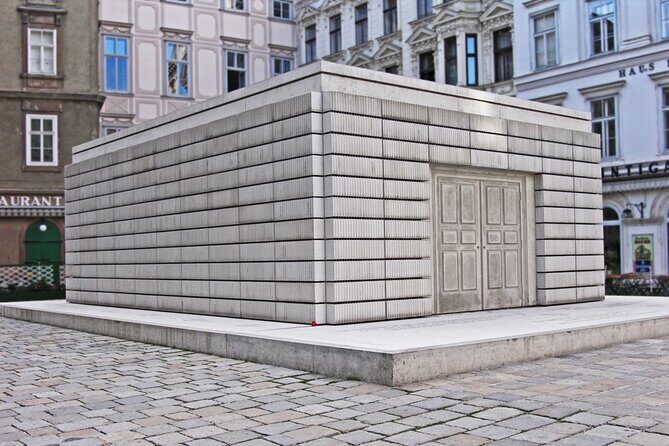
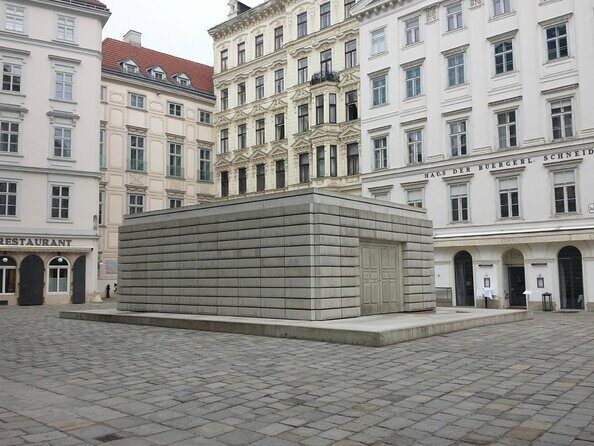
Your final stop is the Judenplatz Holocaust Memorial area at Judenpl., 1010 Wien. This is where the walk ends, about 25 minutes focused time.
This stop combines two kinds of learning. First is the human story: the victims and survivors of Nazi genocide, and the phenomenon of antisemitism in Europe. Second is place-based context: you’ll look at the destroyed synagogues of both Ashkenazi and Sephardic congregations around this area.
The guide’s job here is delicate. You’ll want enough structure to follow the history, and you’ll also want respect in how it’s described. From the way guides have been praised in this tour set, the storytelling usually keeps a steady, reverent tone without rushing.
A good way to approach this emotionally
Think of it as two layers: what happened, and what the city chose to do afterward with that memory. Even if you know the basics of the Holocaust, the antisemitism framing helps you understand that this was not a single isolated crime. It was part of a longer pattern across Europe.
The guides: historians who explain without drowning you in dates
One reason this tour consistently lands well is the people leading it. The program uses historian guides from varied professional backgrounds: professors, doctoral students, historians, journalists, art critics, and published authors.
In past runs, names like Peter, Jan, Webke, Annelie Pichler, and Annalise have shown up as guides. Common praise across these experiences has been their clear explanations and strong storytelling. People also mention how guides help with practical extras like where to eat afterward.
That matters. After a tour like this, you want your next stop to feel grounded in real life, not like you’re continuing a museum marathon.
How the pacing usually feels
The itinerary includes four stops totaling short focused moments, plus walking time between them. The rhythm is designed so you’re not exhausted by the time you reach Judenplatz. It also gives your guide room to adjust pace if questions come up.
What’s included versus not included (and how to avoid surprises)
Included:
- A 2.5-hour stroll covering relevant Jewish heritage and memorial sites with a historian guide
Not included:
- Metro fare
- Admission tickets at certain stops (some stops are free, some are not)
Here’s the practical fix: if you don’t have a visitor pass, the guide helps you purchase metro tickets at the first station. That’s a relief because Vienna’s transit can be easy to overthink when you’re trying to meet a group on time.
Admission specifics you should know:
- Stop 1 has an admission ticket not included
- Stop 2 has an admission ticket not included
- Stop 3 is free
- Stop 4 has an admission ticket not included
Because most stops are outside, you’re not paying to walk up to a memorial. You’re paying for the interpretive context, and for that, the guide is the product.
Group size, timing, and how to get the most out of it
This is capped at a maximum of 8 travelers. That size is small enough that you’re more likely to hear your guide clearly and get personal follow-ups.
Timing-wise, it’s offered in English, and you’ll typically be able to join most travelers. The walk fits well for people who want a focused route without committing to a full-day program.
If you like to linger in memorial spaces, you’re in the right place. The stops are structured to allow reverent viewing, but you still end with momentum and clarity rather than fatigue.
One more practical idea: wear comfortable shoes. The route is short enough to keep it easy, but it’s still a walking tour with real stops.
Who should book this Jewish Vienna walking tour?
I think this tour is a strong choice if you:
- want a guided route through major Jewish Vienna sites without hopping on and off transit nonstop
- care about connecting Jewish religious life, culture, and twentieth-century memory in one flow
- prefer outside-the-building viewing with strong interpretation rather than only museum-style indoor stops
- value a guide who can explain clearly and tell stories that stick
It’s also a good fit for first-timers to Jewish Vienna who don’t want to do everything alone. And if you’re traveling with older family members or a mix of interests, the small group size helps keep the tour manageable.
If you’re only interested in synagogue interiors or have strict access goals, you may feel like something is missing. This tour prioritizes the street-level story and memorial places, with interior access left to synagogue-arranged tours.
Should you book it? My honest take
Book this tour if you want your Vienna sightseeing to have meaning, not just views. The combination of historian-level guidance, a small group, and a route that ends at Judenplatz’s Holocaust Memorial makes it one of the most efficient ways to learn Jewish Vienna with respect and clarity.
I’d skip or pair it with additional visits if you specifically want indoor synagogue tours. The exterior focus is intentional, so plan that separately during the synagogue’s open months and weekdays.
If you’re deciding between doing this and only reading on your own, I’d go with the guided version. This tour is about how to understand what you’re looking at, and that’s exactly where a strong guide earns their place.
FAQ
FAQ
How long is the Jewish Vienna walking tour?
It’s about 2 hours 30 minutes.
Where does the tour start and end?
It starts at Stadttempel, Seitenstettengasse 4, 1010 Wien, Austria. It ends at the Judenplatz Holocaust Memorial, Judenpl., 1010 Wien, Austria.
What language is the tour offered in?
The tour is offered in English.
Is a mobile ticket included?
Yes, the tour includes a mobile ticket.
What is included in the price?
A 2.5-hour stroll through relevant Jewish heritage and memorial sites with a historian guide.
Are there admission tickets included for each stop?
No. Some stops list admission as not included, while Stop 3 (Leopoldstadt) is free.
Is metro fare included?
No. Metro fare is not included, but if you don’t have a visitor pass, the guide helps you buy metro tickets at the first station.
How big is the group?
The tour has a maximum of 8 travelers.
Can I visit synagogue interiors during this tour?
This experience does not include visiting the interior. You can arrange an interior synagogue tour separately with the synagogue’s own guides, open April to October, Monday to Thursday.
What is the cancellation policy?
You can cancel for free up to 24 hours in advance for a full refund. If the tour is canceled because the minimum number of travelers isn’t met, you’ll be offered a different date/experience or a full refund.