REVIEW · VIENNA
The Ringstrasse Project Walking Tour
Book on Viator →Operated by Insight Cities · Bookable on Viator
Vienna’s grand boulevard is easier to understand on foot. The Ringstrasse Project Walking Tour strings together the city’s most recognizable buildings with a guide who points out the why behind the looks. I like that it’s small-group (max 8) and paced so you’re not sprinting between photo spots.
Two things I really like are the focus on context at each stop and the fact that many of the key sights you’ll see don’t require paid entry on the spot. You get a choice of morning or afternoon departure, so you can match the timing to your day in Vienna.
The one possible drawback: at 2 hours 30 minutes, it’s a solid chunk of time. If you’re planning a packed sightseeing schedule right after, you’ll want to leave breathing room—especially because the finale is a café stop that’s part of the experience.
In This Review
- Key Highlights You’ll Actually Feel on the Street
- Vienna’s Ringstrasse Walk: The Fastest Way to Learn What You’re Looking At
- Where You Meet and How the 2.5 Hours Unfold
- Stop 1: Rathaus (Vienna City Hall) and the Neo-Gothic Power Start
- Stop 2: Wiener Staatsoper and Why Opera Matters Here
- Stop 3: Kunsthistorisches Museum Vienna and the Scale of Art Ambition
- Stop 4: Postsparkasse and Otto Wagner’s Style Playing Field
- Stop 5: Stadtpalais Todesco and Salon Culture Behind the Stone
- Stop 6: Café Schwarzenberg and the 19th-Century Café Ritual
- Guides, Personality, and Why the Tour Feels Custom
- Price and Value: Is $177.44 Worth It?
- Who This Walking Tour Suits Best
- Should You Book the Ringstrasse Project Walking Tour?
- FAQ
- How long is the Ringstrasse Project Walking Tour?
- What language is the tour offered in?
- How many people are in the group?
- Where do I meet, and where does the tour end?
- What’s included in the price?
- Are there admission fees at the stops?
Key Highlights You’ll Actually Feel on the Street
- Max 8 people means the guide can slow down, answer questions, and keep it personal
- Free entry tickets at multiple stops lowers the cost of doing this route on your own
- Morning or afternoon departures help you fit the tour around your hotel and other plans
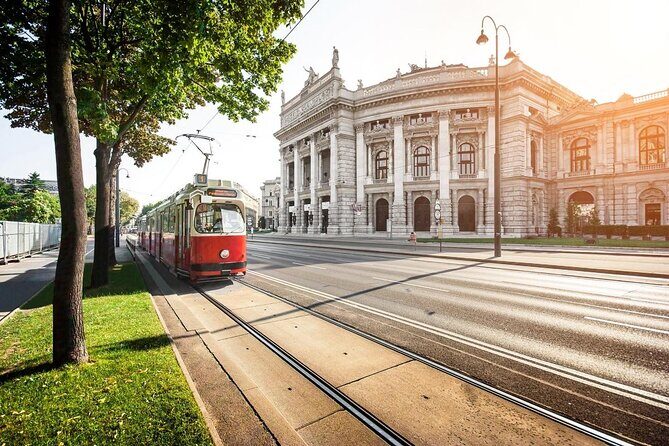
- Ringstrasse architectural variety spans Neo-Gothic, grand theater, museum-scale art, and Art Nouveau details
- Café Schwarzenberg is built into the ending, so the tour ties history to everyday Vienna life
Vienna’s Ringstrasse Walk: The Fastest Way to Learn What You’re Looking At
Vienna’s Ringstrasse isn’t just a pretty loop of landmark buildings. It’s a visual lesson about power, culture, and taste—printed in stone and glass over decades of building. On this walking tour, the big advantage is that the route is structured like a story. You see the grand civic start, then the opera and museum world, then you move into style experiments and the salon culture that helped shape intellectual life.
I also like the “local streets first” feel. Even though you’re centered on famous architecture, the walking approach keeps you grounded in the city’s street level. That matters because Vienna looks different from the sidewalk than it does from a postcard angle. You notice entrances, spacing, and scale—stuff you can miss when you only hop on and off at stops.
The tour is also designed for real-world touring: it’s offered in English, it runs about 2 hours 30 minutes, and you’re not dealing with hotel pickup drama. You show up, meet the group, and the guide handles the rhythm.
You can also read our reviews of more walking tours in Vienna

Where You Meet and How the 2.5 Hours Unfold
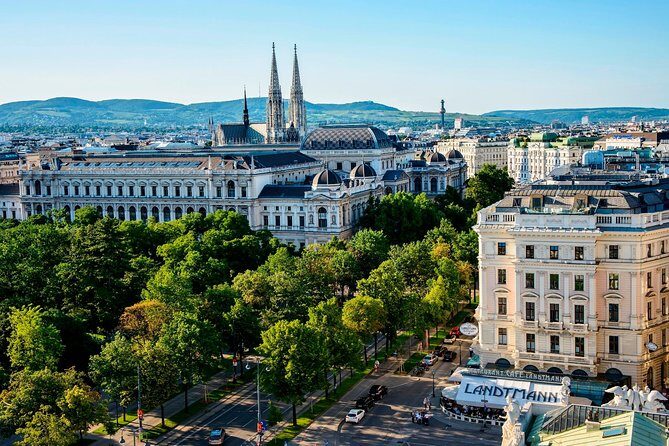
You meet at Café Landtmann, Universitätsring 4, 1010 Wien, and the tour ends at Café Schwarzenberg, Kärntner Ring 17, 1010 Wien. Both are in the Ring area, so you’re already in the right neighborhood for the biggest sights and the best street atmosphere.
The timing is set around short stop visits—about 15 to 25 minutes each, depending on the location—so you get enough time to look closely without turning the tour into a long queue-fest. The walking segments between stops are what keep it flowing. You’re meant to move, look, then listen, instead of standing in one place for the whole time.
There’s also a practical upside to the small group limit of up to 8 people. On a route like this, group size affects how often you can get close to the façade details and still hear the guide. With fewer people, it’s easier to actually see what’s being pointed out.
Stop 1: Rathaus (Vienna City Hall) and the Neo-Gothic Power Start
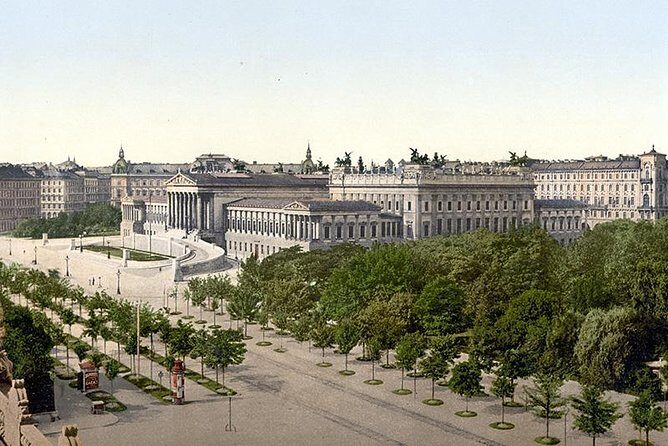
The tour kicks off at Rathausplatz with Vienna City Hall (Rathaus). Construction ran 1872 to 1883, and the style is Neo-Gothic—a signal that the city wanted its civic identity to look both official and timeless. The building serves as the seat of local government, including the office of the mayor and chambers for the city council and the Vienna Landtag diet.
Why this first stop works so well: Rathaus sets the tone for the entire Ringstrasse idea. You’re looking at architecture that’s meant to communicate authority. Even if you don’t care about politics, you can read the intent in the façade—structure, seriousness, and formality.
You’ll also get a quick moment to orient yourself visually. After this, everything else on the Ring makes more sense because you know what kind of ambitions Vienna was projecting in the late 19th century.
Stop 2: Wiener Staatsoper and Why Opera Matters Here
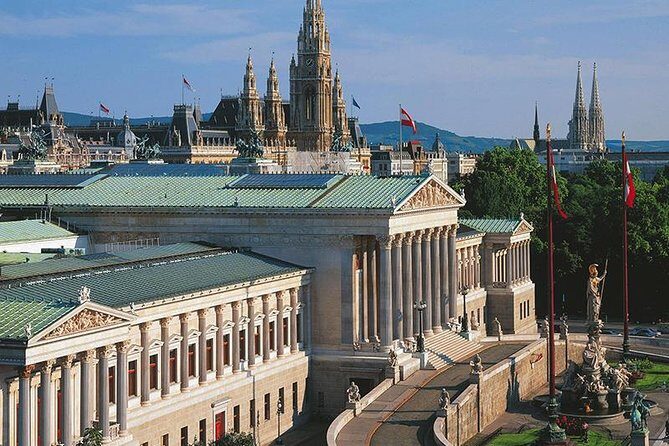
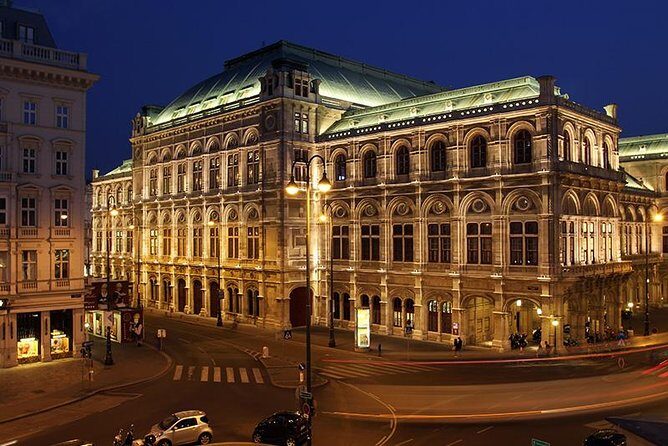
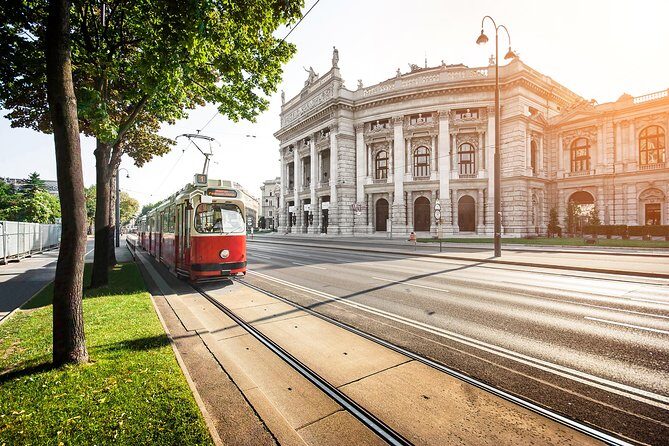
Next comes Wiener Staatsoper (Vienna State Opera). This is the first major building on the Ring road and a clear statement about what Viennese culture prioritized. It opened for a time when opera wasn’t just entertainment—it was a civic event tied to identity and prestige.
The building sits in the period 1861 to 1869, and it has 1,709 seats. You don’t need to be an opera buff to appreciate the lesson here. The tour helps you see that this isn’t a random theater. It’s a landmark that reflects the city’s self-image.
One consideration: this stop is mostly an exterior-focused viewing. If you’re hoping for a deep inside-the-auditorium experience, this specific tour segment won’t be that. Still, you’ll leave with a better sense of why the opera-house placement on the Ring was such a big deal.
Stop 3: Kunsthistorisches Museum Vienna and the Scale of Art Ambition
Then you shift into the art world at Kunsthistorisches Museum Vienna. The name refers both to the institution and the main building. The museum is the largest in Austria and counted among the major art museums worldwide.
At this stop, the value is in learning what kind of message museums were built to send. On the Ring, cultural buildings sit alongside civic and economic power structures. That’s the point: culture isn’t a side note in Vienna. It’s part of how the city branded itself.
A practical note: while this tour gives you time to look and absorb, it won’t replace a full museum visit. If you want to spend hours inside later, this is a strong primer. If you only have a day or two in Vienna, it still gives you a meaningful “big picture” understanding of the city’s priorities.


Stop 4: Postsparkasse and Otto Wagner’s Style Playing Field
Now you get into style and design at Postsparkasse, the Austrian Postal Savings Bank building. It was designed and built by Otto Wagner, and it’s regarded as an important work tied to the Vienna Secession, which overlaps with Art Nouveau ideas.
This is where the tour gets fun if you like architecture that breaks the rules. Wagner’s work is often about form, materials, and the sense that design can be modern without losing craft. On this Ringstreets section, you can feel the change from the more solemn monumental styles toward buildings that show experimentation.
The stop duration is about 20 minutes, which means you’ll likely have time for a solid look at the façade and key details the guide points out. If your eyes love lettering, ornament, and building “signals,” this is one of the more rewarding stops.
Stop 5: Stadtpalais Todesco and Salon Culture Behind the Stone
Next you visit Stadtpalais Todesco, built between 1861 and 1864 for the aristocratic Todesco family. This is a Ringstraßenplatz site—so it’s not just a building face; it’s part of a public setting. One notable resident was Baroness Sophie von Todesco, who established a renowned salon for artists and intellectuals.
This is a great pivot point. You’ve seen institutions that run cities and stage big public culture. Here, the theme shifts to conversation and ideas—how social spaces helped shape art, thought, and influence in Vienna.
If you like learning how power worked in the everyday social world (not only through governments and theaters), this stop lands well. It turns the Ring from a photo walk into a cultural map.
Stop 6: Café Schwarzenberg and the 19th-Century Café Ritual
The tour ends at Café Schwarzenberg, a traditional Viennese coffee house on the Ring. The tour gives you about 25 minutes here, and it’s designed for more than a quick drink. Café Schwarzenberg opened in 1861, and the interior is notable for remaining largely unchanged since it opened—so you’re seeing a living link to the later 1800s.
This is where the guide’s work really pays off. The Ringstrasse wasn’t only for monuments. It was also a place to see and be seen. Ending at a café turns that idea into something you can experience with your own senses: the mood, the room, the feel of a classic Vienna meeting place.
One practical consideration: food and drinks aren’t included. You’ll want to decide in advance whether you’re just here to soak up the atmosphere or you plan to order something.
Guides, Personality, and Why the Tour Feels Custom
The experience is built for personal attention. With a group cap of 8, you’ll usually get room for questions and quick clarifications. That matters on a boulevard like the Ringstrasse, because architecture can feel abstract if nobody helps you read it.
The guide element is consistently praised. Names like Sussana and Biljana come up as professional, friendly, and humorous, with strong understanding of Vienna. Even when you’re not a building expert, a guide who can explain the symbolism behind choices in style helps you look with better accuracy.
There’s also a nice flexibility factor: if the group is small—sometimes even when only one person is booked—the tour can still run and feel tailored. That’s a big quality-of-life detail. You don’t get stuck with a rigid script that only works for a full bus of people.
Price and Value: Is $177.44 Worth It?
At $177.44 per person, this isn’t the cheapest way to see the Ringstrasse. But you’re paying for three things that add up quickly: a professional guide, a 2.5-hour structured route, and a setup where multiple stops have free admission tickets.
Here’s how I’d judge the value for you:
- If you want an organized route with context, the guide time is doing real work.
- If you would otherwise bounce between spots with no explanation, this helps you learn faster, not slower.
- The free stop entry detail reduces the “surprise costs” that often hit when you DIY major sights.
It still may not be the best deal if you’re traveling with someone who already knows Vienna deeply and prefers independent exploration. But for most people, the cost makes sense because the tour converts landmark viewing into understanding.
Who This Walking Tour Suits Best
This is ideal if you want a guided path through Vienna’s Ringstrasse without planning a full day of logistics. It also suits people who like architecture but don’t want to guess what each building is saying.
A good fit if:
- you want a first-timer-friendly sense of the Ring area
- you appreciate short stops with explanation rather than long museum marathons
- you’d like the tour in English
- you want a tour with a maximum of 8 so it stays friendly
It’s also available as a children’s family tour where the guide focuses on symbols on buildings and everyday life in Vienna around 1900. If you’re traveling with kids, that can be a big win: you’ll get structure without turning it into pure lecture mode.
Should You Book the Ringstrasse Project Walking Tour?
If you’re in Vienna and you want the Ringstrasse to make sense, I think this is a smart booking. The stop selection hits the big themes—civic identity, opera and music culture, art ambition, Secession-style design, and salon life—then it lands where many visitors remember Vienna best: a classic coffee house.
I would book it if you value a small-group, guided interpretation over wandering. I’d reconsider if you’re the type who only wants to enter museums and theaters for long stretches, because this tour is designed for street-level learning and a café finish, not extended indoor time.
If you want a clean way to turn famous façades into a story you’ll remember, this one is built for that.
FAQ
How long is the Ringstrasse Project Walking Tour?
The tour runs for about 2 hours 30 minutes.
What language is the tour offered in?
The tour is offered in English.
How many people are in the group?
It has a maximum of 8 travelers.
Where do I meet, and where does the tour end?
You start at Café Landtmann on Universitätsring 4, 1010 Wien, and the tour concludes at Café Schwarzenberg on Kärntner Ring 17, 1010 Wien.
What’s included in the price?
The price includes a 2.5-hour guided tour of Vienna’s Ringstrasse and a professional guide.
Are there admission fees at the stops?
The tour lists free admission ticket access for the stops included on the route.